

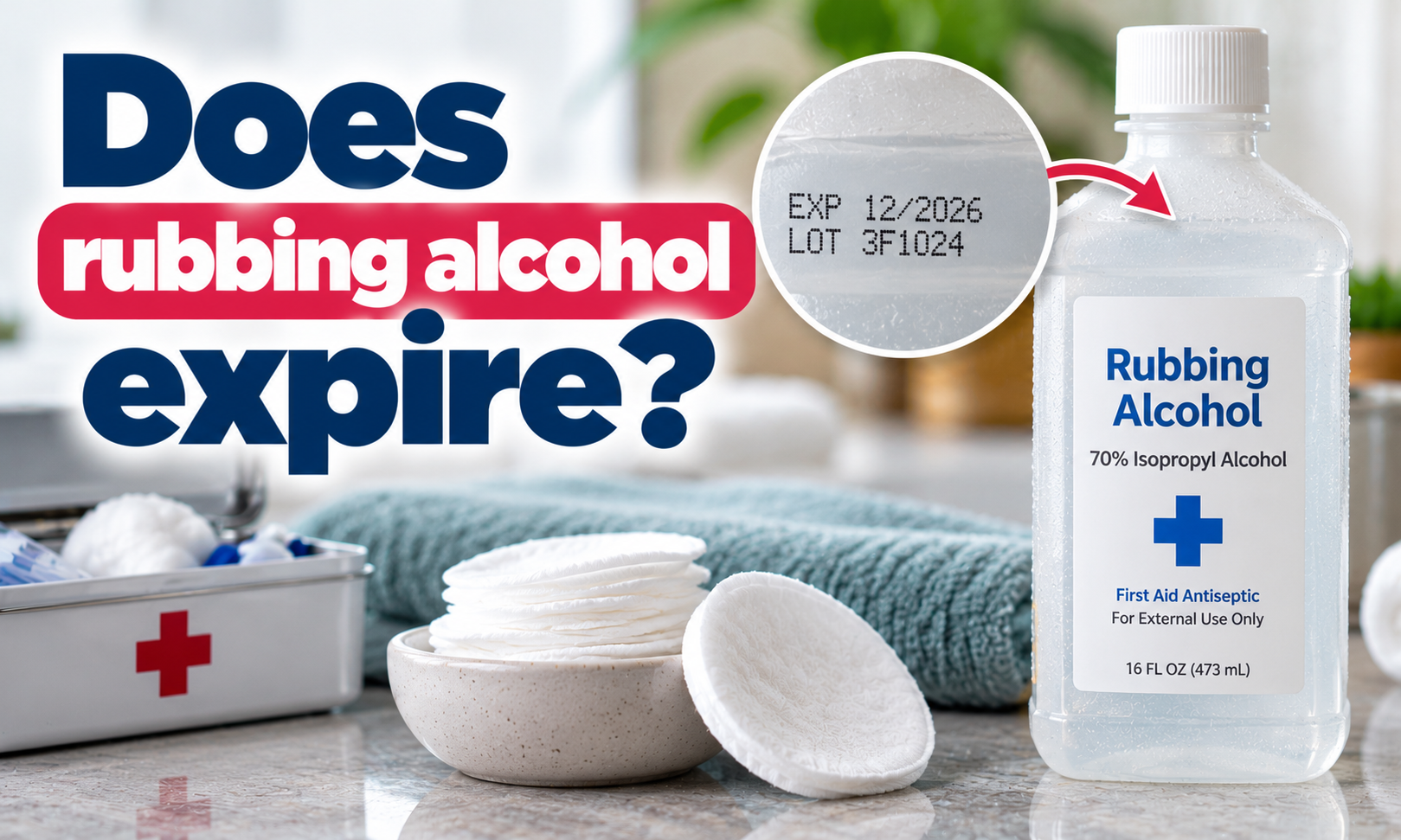
Yes, does rubbing alcohol expire? It does. A bottle of rubbing alcohol can gradually become less reliable after its printed expiration date, largely because isopropyl alcohol is volatile and can evaporate over time. As the alcohol concentration falls, its ability to disinfect can also drop. The exact shelf life depends on the product and manufacturer, so the date on the label is more useful than assuming every bottle lasts the same number of years.
For most household uses, the safest approach is simple: check the expiration date, keep the cap tightly closed, store the bottle away from heat and flames, and replace it when you need dependable disinfection. This guide explains what actually changes inside an older bottle, how to store rubbing alcohol correctly, when expired product may no longer be appropriate, and how to dispose of or replace it safely in a US household.
What Exactly Is Rubbing Alcohol?
Rubbing alcohol sold in US pharmacies and supermarkets is commonly based on isopropyl alcohol, also called isopropanol. A familiar formulation contains 70% isopropyl alcohol and 30% water, although other concentrations exist. Alcohol works as a disinfectant by damaging proteins and membranes in many microorganisms. The CDC notes that alcohol solutions in the 60% to 90% range have strong antimicrobial activity, while activity drops sharply when the concentration falls below 50%.CDC guidance on chemical disinfectants
Why Does Rubbing Alcohol Expire?
The key issue is evaporation. Isopropyl alcohol evaporates readily, including from a bottle that is opened repeatedly. If some alcohol escapes while the water remains behind, the mixture can slowly become more diluted. That matters because disinfecting performance depends partly on alcohol concentration.
A bottle does not usually become dangerous the day after the printed date. Instead, the concern is reliability. You may no longer know whether the product still has the concentration needed for the job. This is especially important when you are using it for a task where germ reduction matters, rather than for a low-stakes cleaning job.
How Long Does Rubbing Alcohol Usually Last?
Many consumer bottles are labeled with an expiration date several years after manufacture, and the reference article notes that two to three years is common for some products. However, there is no universal household shelf life that applies to every brand and concentration. Always treat the manufacturer’s printed expiration date as the primary guide.
An unopened bottle generally maintains its intended concentration better than one that has been opened repeatedly, particularly if the closure is tight and storage conditions are stable. Once opened, every use creates an opportunity for vapor to escape.
| Situation | What may happen | Best approach |
| Unopened and within date | Concentration is most likely to match the label | Store correctly and use as directed |
| Opened but within date | Some evaporation is possible over time | Keep tightly capped and avoid heat |
| Past expiration date | Alcohol concentration may be lower or uncertain | Replace it when dependable disinfection is needed |
| Cap left loose or bottle stored hot | Faster evaporation can occur | Do not rely on it for critical disinfection |
Is Expired Rubbing Alcohol Still Safe to Use?
Expired rubbing alcohol is not automatically toxic simply because the date has passed. The bigger issue is that it may be less effective. For routine household cleaning where disinfection is not essential, an older bottle may still remove some residue or grime. But if you need a dependable antiseptic or disinfectant, using a fresh, in-date product is the safer choice.
Do not use rubbing alcohol as a substitute for medical care, and avoid pouring it into serious wounds, burns, or deep cuts. For routine hand hygiene, soap and running water are preferred when available. If you are using any antiseptic before an injection or another medical procedure, follow the instructions provided by the healthcare professional or product manufacturer.
How Can You Tell If Rubbing Alcohol Has Gone Bad?
Unlike spoiled food, rubbing alcohol may not develop an obvious bad smell or visible mold. The liquid may look completely normal even if some alcohol has evaporated. That is why appearance is not a dependable test of strength.
- Check the printed expiration date on the bottle or label.
- Look for a damaged cap, cracked bottle, or evidence that the seal no longer closes tightly.
- Consider how it was stored. Repeated exposure to heat can increase evaporation.
- Do not assume that a strong alcohol smell proves the concentration is still correct.
- Replace the product if you need predictable germ-killing performance and the age or storage history is uncertain.
Does the Alcohol Percentage Matter?
Yes. Higher is not always better for disinfection. The CDC reports that alcohol solutions in the 60% to 90% range are effective against many microorganisms, and alcohols can lose much of their germicidal activity when diluted below 50%. A 70% isopropyl alcohol product is common because water helps slow evaporation and supports protein denaturation during disinfection.
This is one reason expiration matters. If an old bottle has lost enough isopropyl alcohol through evaporation, the remaining solution may no longer perform as expected even if it still looks and smells normal.
How Should You Store Rubbing Alcohol?
Proper storage helps preserve the product and reduces safety risks. Isopropyl alcohol is highly flammable. The CDC’s NIOSH Pocket Guide lists a flash point of about 53°F for pure isopropyl alcohol, meaning its vapors can ignite easily under the right conditions.NIOSH information on isopropyl alcohol
- Keep the bottle tightly capped when not in use.
- Store it in the original labeled container.
- Keep it in a cool, well-ventilated location away from direct sunlight.
- Keep it away from candles, stoves, space heaters, sparks, and other ignition sources.
- Store it out of reach of children and pets.
- Do not transfer it into a drinking bottle or an unlabeled container.
What Should You Use Instead of Expired Rubbing Alcohol?
The best replacement depends on the task. For hands, regular washing with soap and water is appropriate for everyday hygiene. For household surfaces, clean visible dirt first and then use a disinfectant that is appropriate for the surface and used according to its label directions. A fresh bottle of rubbing alcohol can also be useful for compatible small surfaces.
Avoid improvising by mixing cleaning products. Combining chemicals can create irritating or dangerous fumes. Also remember that rubbing alcohol can damage some plastics, finishes, coatings, rubber components, and electronics if used incorrectly, so check the manufacturer’s cleaning instructions first.
What If Someone Swallows Rubbing Alcohol?
Rubbing alcohol is for external use and can cause poisoning if swallowed. Symptoms may include vomiting, drowsiness, poor coordination, stomach irritation, low blood pressure, and more serious complications after larger exposures. Poison Control advises storing rubbing alcohol in its original container and keeping it out of children’s reach.Poison Control guidance on rubbing alcohol
In the United States, contact Poison Control at 1-800-222-1222 or use webPOISONCONTROL for exposure guidance. Call 911 for severe symptoms, trouble breathing, loss of consciousness, or another life-threatening emergency.
Quick Guide: Keep It or Replace It?
| Condition | Recommendation |
| Within date, tightly sealed, stored properly | Generally fine to use as labeled |
| Past date, but only needed for noncritical cleaning | May still be usable, but strength is uncertain |
| Past date and needed for disinfection | Replace with a fresh product |
| Unknown age or stored with a loose cap | Replace it |
| Bottle is damaged, leaking, or label is unreadable | Do not rely on it; replace and dispose of it safely |
Frequently Asked Questions
Can rubbing alcohol expire if it has never been opened?
Yes. Even unopened products carry an expiration date. A sealed bottle is better protected from evaporation, but the manufacturer’s date is still the best guide for expected performance.
Can I use expired rubbing alcohol on my skin?
An expired product may have an uncertain alcohol concentration, so it is better to use an in-date antiseptic when reliable germ reduction matters. Avoid applying rubbing alcohol to serious wounds or burns unless a healthcare professional specifically instructs you to do so.
Does 70% rubbing alcohol last longer than 91%?
Shelf life depends on packaging, formulation, storage, and the manufacturer. Do not assume one concentration automatically lasts longer. Check the label on the specific product.
Will rubbing alcohol turn into water when it expires?
No. It does not suddenly become water. However, isopropyl alcohol can evaporate more readily than water, so the remaining mixture may gradually contain a lower percentage of alcohol.
Can I pour old rubbing alcohol down the drain?
Disposal rules can vary by locality and quantity. Because isopropyl alcohol is flammable, follow the product label and your local household hazardous waste guidance rather than disposing of a large amount casually.
Is expired rubbing alcohol better than nothing?
For low-stakes cleaning, it may still have some usefulness. For medical preparation, antisepsis, or dependable disinfection, use a fresh product with a known concentration instead.
The Bottom Line
Rubbing alcohol does expire, but expiration is mainly a question of declining reliability rather than the liquid suddenly becoming harmful on a specific date. Because isopropyl alcohol evaporates readily, an older or poorly sealed bottle can become more diluted and less effective as a disinfectant. Check the printed date, keep the cap tightly closed, store the bottle away from heat and flames, and replace it when you need predictable germ-killing performance. If a bottle is very old, damaged, or has an unknown storage history, a fresh bottle is a simple and inexpensive way to remove uncertainty.
